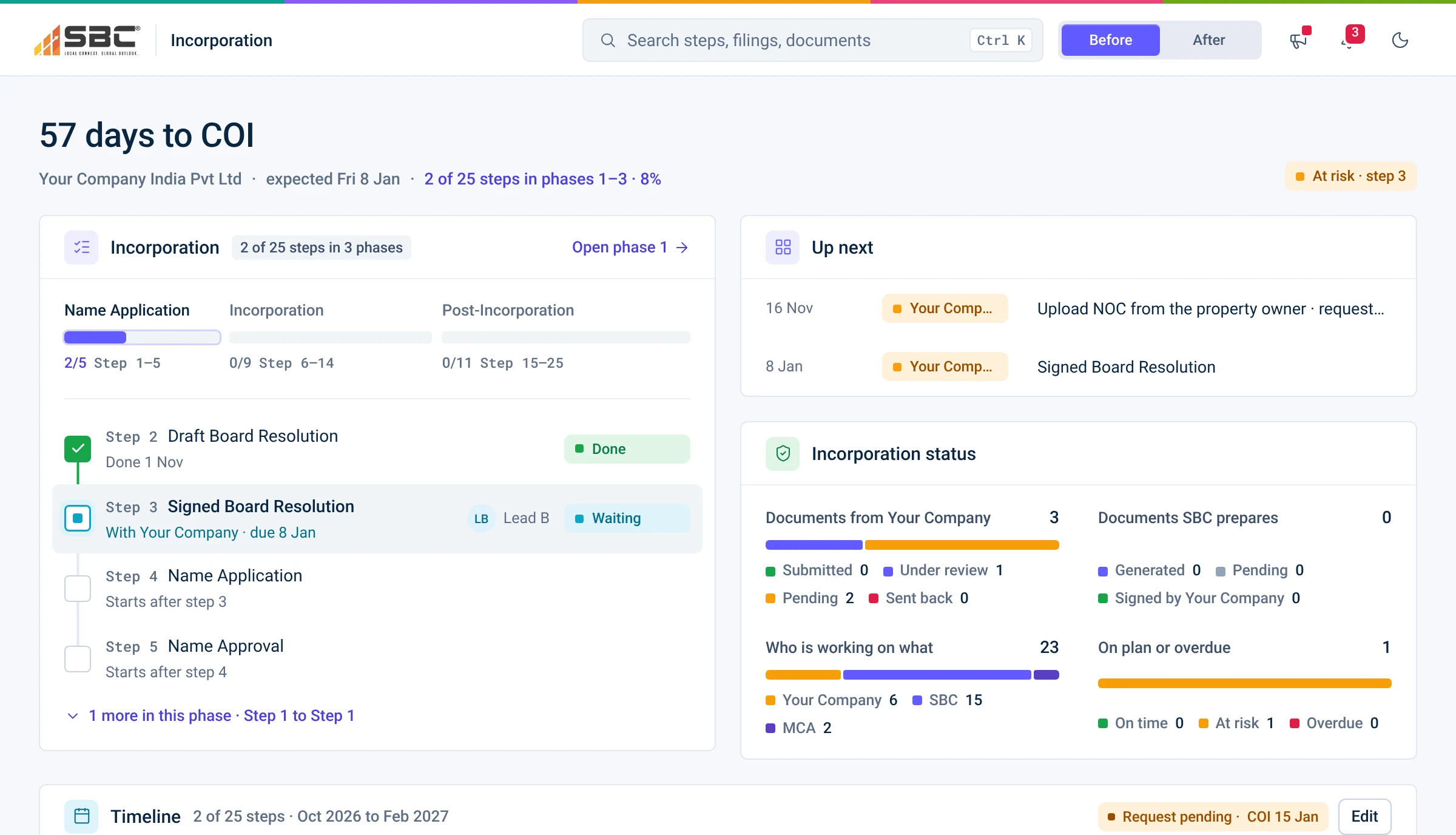
steps in every incorporation, from the name application to the post-incorporation filings. Registrations have their own page.
0
registrations and RBI reportings after the certificate, from PAN and GST to FC-GPR.
0
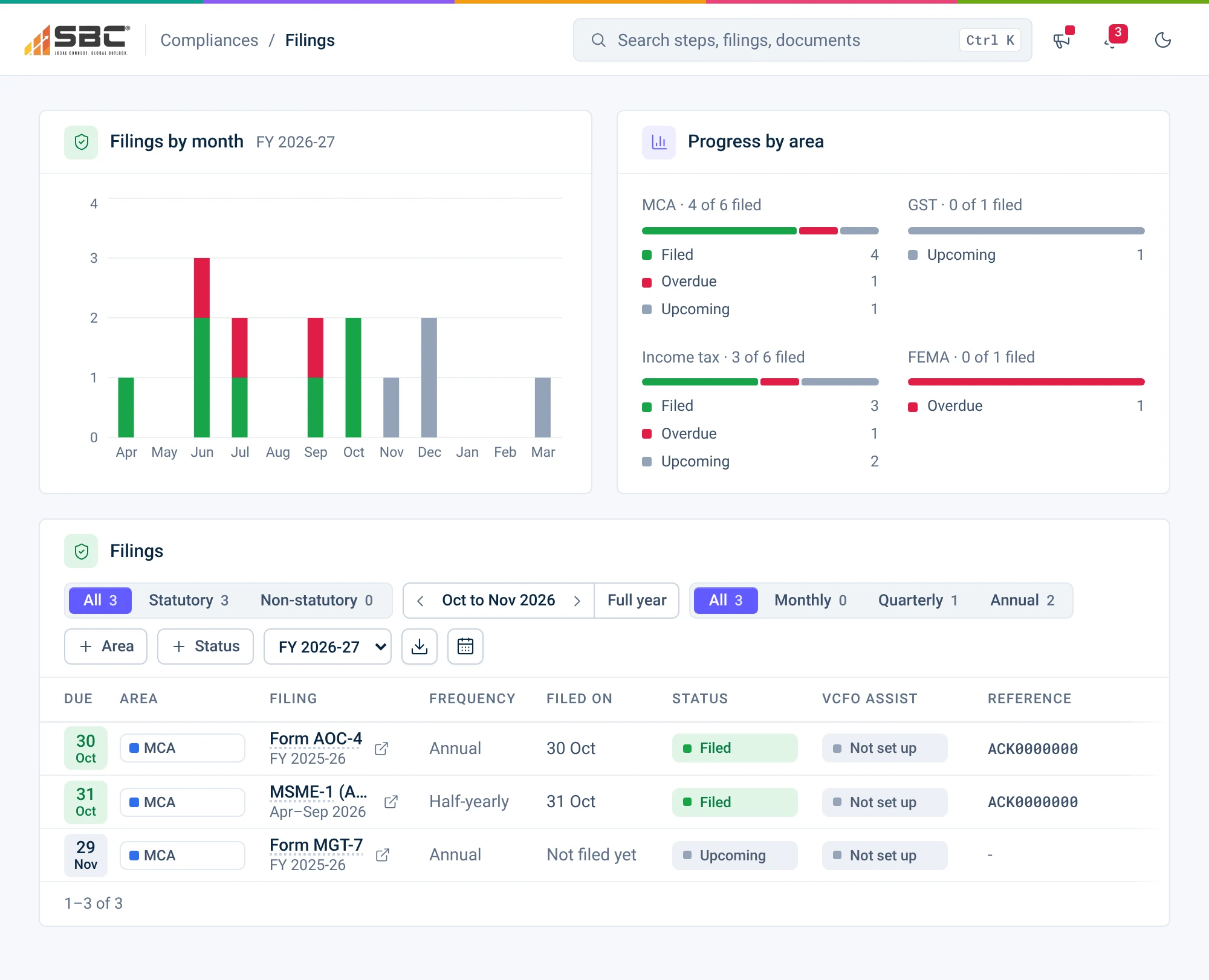
regulators on one statutory calendar: MCA, GST, Income tax, Payroll, FEMA and Labour.
0
record that the client, the parent entity and the firm all read, with the same status words.
What happens to a company, start to finish.
Four stages happen once. The calendar repeats every year. The firm runs every step; the client sees every step, with who holds it and when it is due.
Name and papers5 steps, about 2 weeks. Client and firm.
Incorporation11 steps, SPICe+ with MCA. Firm and MCA.
Certificate of IncorporationDay 0. CIN, PAN and TAN arrive.
The first 45 days11 steps the law gives up to 180 days for. The firm.
Registrations24 items, only the ones that apply. The firm.
Compliance, every yearMonthly, quarterly and annual filings. Firm and client.
Every node on this line is a page in the portal, and every step on that page shows the same three things: who holds it, when it is due, and the document that proves it.
1Stages 1 and 2
From a name on a wish list to a certificate from MCA.
Sixteen steps pass between the client, the firm and the Ministry of Corporate Affairs. The diagram follows one document at a time. Scroll, and watch it move.
The client tells you about the company
Names they like, the directors, the share capital, the registered office and the parent company. One questionnaire, answered once. Every document after this is generated from it.
CClientFFirm reviews
A board resolution, drafted and signed
You draft the resolution from their answers. The client prints it on the parent letterhead, signs, and uploads. The project lead checks it the same day.
FFirm draftsCClient signs
The name is reserved with MCA
You file the name application. MCA usually answers within a week, and the approved name is held for 20 days while the rest is prepared.
FFirm filesMMCA approves
Documents generated, signed with a digital signature
The memorandum, the articles, each director's consent (DIR-2) and declaration (INC-9), the subscriber sheets: all generated, not retyped. Directors get a digital signature and sign.
FFirm generatesCDirectors sign
SPICe+ filed, certificate issued
You file SPICe+ Part B with AGILE-PRO-S. If MCA raises remarks, you answer them. Then the Certificate of Incorporation arrives with the CIN, PAN and TAN, and the clock for stage 3 starts.
FFirm filesMMCA issues
3Stage 3
The first 45 days after the certificate.
The law gives up to 180 days for some of these steps. The firm closes all eleven in about 45, and the portal still counts every statutory deadline and sends a reminder before each one runs out.
11 stepsDone in about 45 daysThe law allows up to 180
DAY 071530DAY 45
Day 0Certificate of IncorporationCIN, PAN and TAN arrive. Every clock starts today.
By day 7Bank account, letterhead and name boardThe account opens as soon as the bank clears KYC.Law: 30 days · bank: no clock
By day 15First board meeting, and what it decides
Auditor appointed (ADT-1)
Registered office confirmed (INC-22)
Nominee shareholder forms (MGT-4, 5, 6)
Law: 30 days
By day 30Capital in, share certificates (SH-1)The parent sends the subscription money, the shares are allotted and the certificates issued.Law: SH-1 within 60 days
By day 45FC-GPR and commencement (INC-20A)FC-GPR goes to the RBI and INC-20A is filed. The company may start business, and Stage 4 begins.Law: FC-GPR 30 days after allotmentLaw: INC-20A 180 days
Day 0Certificate of IncorporationCIN, PAN and TAN arrive. Every clock starts today.
By day 7Bank account, letterhead and name boardLaw: 30 days; the bank account has no clock.
By day 15First board meeting, auditor (ADT-1), registered office (INC-22), nominee shareholder formsLaw: 30 days.
By day 30Capital in, share certificates (SH-1)Law: SH-1 within 60 days.
By day 45FC-GPR and commencement (INC-20A)Law: FC-GPR 30 days after allotment; INC-20A 180 days.
Day targets assume the bank clears KYC and the parent sends the capital on time. The portal still counts each statutory deadline, and the client sees the same countdown the project lead sees.
4Stage 4
Every registration and filing the company needs, and none it does not.
Thirty-two registrations, reportings and MCA filings across six areas. The firm switches on the ones that apply to the company, and each becomes a step with an owner and a date.
A software subsidiary with no exports never sees IEC or ICEGATE. A company with no foreign capital never sees FC-GPR. The MCA filings run on their own clocks from the certificate date and the financial year.
∞Every year
Then the calendar takes over.
A private company files something almost every week of the year. Every filing on this ring has a due date, an owner and a reminder in the portal. Nothing depends on someone remembering.
What a financial year looks like
GST. GSTR-1 by the 11th and GSTR-3B by the 20th, every month. GSTR-9 once a year.
Income tax. TDS paid by the 7th each month, TDS returns each quarter, advance tax in June, September, December and March, Form 16 in June.
MCA. MBP-1 and DIR-8 in April, MSME-1 twice a year, DPT-3 in June, DIR-3 KYC in September, AOC-4 and MGT-7 after the annual general meeting.
Labour. Professional tax by the 10th, PF and ESI by the 15th, every month.
RBI. The FLA return by 15 July for every company with foreign capital.
Due datefrom the calendar
Reminderemail is the record, WhatsApp the reminder
Filedacknowledgement attached
The same year, inside the portal
What the client sees: one month at a time, filtered by regulator, with the next deadline counting down and every filing after it in a list.
Filings, with proof. Each row carries its due date, frequency, status word and the acknowledgement once filed. Overdue is a word in red, never a surprise.
Every step has an owner, a date and a proof.
Work enters as a step, a filing or a document request. The firm reviews it. It leaves as a status word with a date behind it, and the client reads the same word the firm reads.
Owner
The client, the firm or MCA. Never "someone".
Due date
Statutory where the law sets one, agreed where it does not.
Document
The upload, the generated form or the filed acknowledgement.
Audit entry
Who changed what, and when. Clients can read their own trail.
Firm reviewOn record
StepKYC review and DSC
FilingGSTR-3B, Sept
DocumentProof of address
FilingADT-1 appointment
StepSubscriber details
In progress
Filed 20 Oct
Needs you
Due 14 Nov
Completed
The VCFO way vs. the old way
Spreadsheets break when compliance stops being routine.
VCFO Suite compared with the old way
Generic task tool
Spreadsheets and email
Every incorporation step tracked, from name to certificate
By hand
The client sees what waits on them, live
MCA, GST, Income tax, Payroll, FEMA and Labour on one calendar
Late filings flagged before the fees build up
By hand
Each step has an owner, a date and a proof
By hand
Firm and client read one record, with the same words
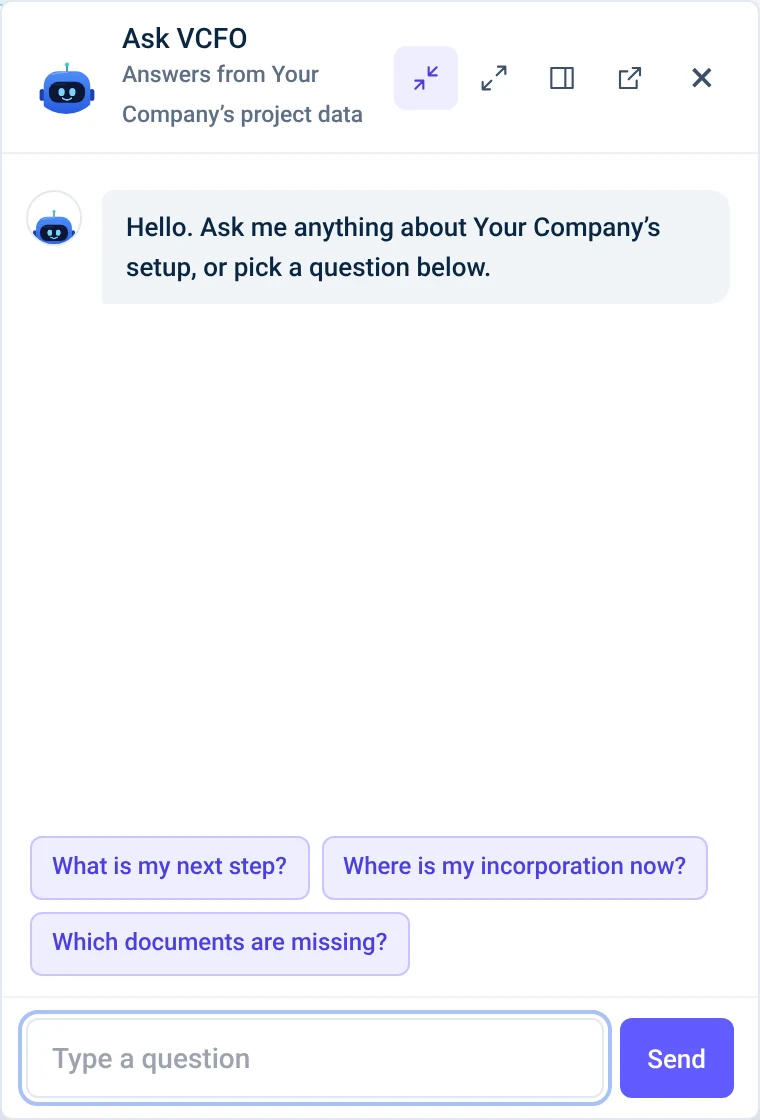
Ask VCFO answers from the project, not from a brochure.
A client asks where the incorporation stands, which documents are missing or when a filing is due, and gets the answer from their own engagement data. Anything the assistant cannot answer is handed to the firm's team with the context attached.
What is my next step?
Where is my incorporation now?
Which documents are missing?
Built by a firm that files, for firms that file.
SBC, a company secretarial and compliance practice, built VCFO Suite and runs its own engagements on it every day. Your firm gets the same system: your people, your clients, one record.
Hosted in India
AWS Mumbai region, encrypted storage. Client data does not leave the country.
Credentials stay sealed
Portal and registration logins are stored encrypted and shown only to the people on the engagement.
An audit trail you can read
Every change is logged with who and when. Clients see their own trail in the portal.
Email is the record
Every notice goes by email. WhatsApp is a reminder on top, never the only copy.
Questions clients ask before the first step.
Who is VCFO Suite for?
Firms that incorporate and keep companies compliant in India, and their clients: Indian founders, and foreign parents setting up a subsidiary or a global capability centre. The firm, the Indian team and the parent entity all log in to the same record.
Is it only for SBC?
No. SBC built it and runs its engagements on it, which is why every screen on this page is a real one. Another firm gets its own workspace, with its own people, clients and calendar.
What does the client actually do in the portal?
Answer the questionnaire, upload the documents each step asks for, approve board resolutions, sign with a DSC, and watch the timeline. Questions go to Ask VCFO or to the people named on the engagement.
Which filings does the calendar cover?
MCA, GST, Income tax, Payroll, FEMA and Labour obligations for the financial year, generated from the certificate date and the registrations the company holds. Each one carries its statutory due date.
How are we reminded?
Every due date emails the owner of the step. With consent, a WhatsApp reminder goes out as well. The email is always the record; WhatsApp never replaces it.
Where is our data hosted, and who can see it?
On AWS in the Mumbai region, with encrypted storage. Access is scoped by role, so a client sees only their own companies and the firm's people assigned to them.
Your clients.Their filings.Your team.All on one record.